
What Is Revenue Architecture and Why It Matters
Revenue architecture is the deliberate design of how a B2B company generates, retains, and expands revenue across the full customer lifecycle. Most companies do not have one. They have a marketing function, a sales function, a customer success function, and a CRM that nobody fully trusts, all running parallel playbooks that touch the same customer at different times.
That gap is why predictable growth feels so rare in the B2B world right now.
What Revenue Architecture Actually Means
Revenue architecture treats revenue generation as a system, not a department. The term was popularised by Jacco van der Kooij and Winning by Design as a response to a structural problem: B2B go-to-market teams are organised by function, but customers experience them as one continuous journey.
A revenue architecture defines how every stage of that journey connects. How leads are created, qualified, closed, onboarded, expanded, and renewed. It specifies which team owns which moment, what hand-off looks like, what data flows between stages, and which metric proves the stage is healthy.
It is closer in spirit to engineering architecture than to sales strategy. You design it once, then you operate it.
Why It Matters Now
Three pressures have made revenue architecture an executive-level concern, instead of an internal RevOps debate.
CAC has risen sharply across B2B. Public SaaS benchmarks consistently show that customer acquisition costs have climbed materially over the last five years, in some segments more than doubling. Companies cannot afford to leak qualified pipeline because marketing, sales, and customer success use different definitions of a "qualified" account.
Forecasting accuracy has dropped. Recent industry surveys from Gartner and Salesforce report that the majority of B2B sales leaders miss their quarterly forecast, often by more than 10%. Without a shared architecture, the forecast is an opinion stitched together from three other opinions.
The revenue team is more fragmented than ever. A growth-stage B2B company today typically runs marketing automation, a CRM, a sales engagement platform, a customer success tool, a data warehouse, and a BI layer. Without architecture, each of those tools optimises locally and the system underperforms globally.
The Four Layers of a Revenue Architecture
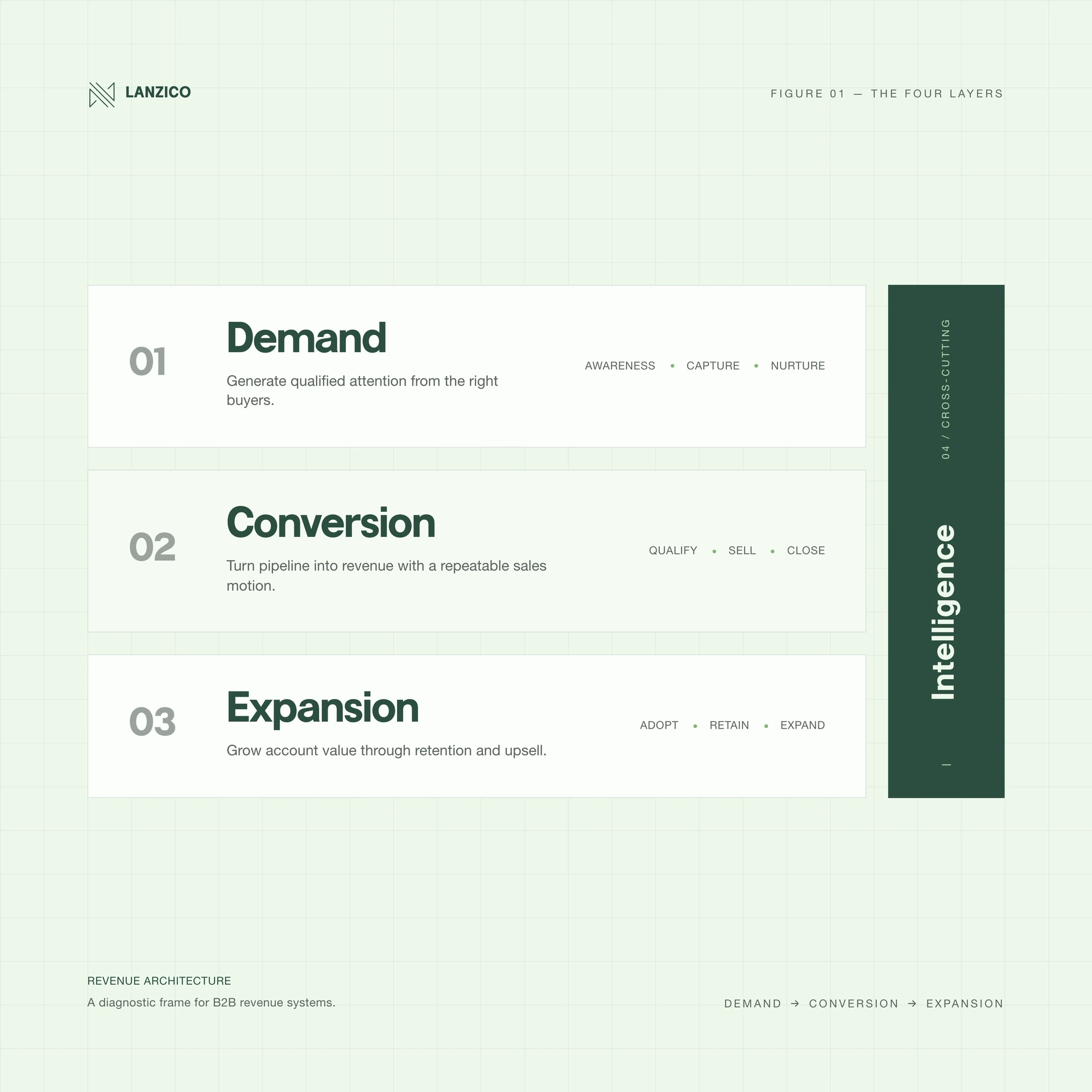
Every functioning revenue architecture has four layers. If any one of them is missing or owned by nobody, the whole system gets shaky.
- Demand How the company creates qualified pipeline. Outbound, inbound, partnerships, events, content, paid acquisition. Demand owns the question: are we filling the funnel with the right accounts at the right cost?
- Conversion How pipeline becomes revenue. Sales process, qualification methodology, opportunity stages, win-loss analysis, closing motion. Conversion owns the question: are we winning the deals we should be winning?
- Expansion How existing revenue grows. Customer success, renewals, upsell, cross-sell, referrals, advocacy. Expansion owns the question: is each customer worth more in year two than in year one?
- Intelligence The data, metrics, and forecasting layer that observes the other three. CRM hygiene, KPI definitions, dashboards, attribution, forecast model. Intelligence owns the question: do we know what is actually happening, in time to act on it?
The layers are sequential in the customer journey but parallel in operation. They must be designed together.
Common Failure Modes
A handful of patterns show up in nearly every B2B audit LanziCo runs.
Local optimisation - Marketing celebrates MQLs that sales never closes. Sales hits revenue targets by discounting, eroding the expansion layer. Each function looks healthy in isolation, the company underperforms.
Tool-first thinking - Leaders try to fix architecture problems by buying software. New CRM, new attribution platform, new customer success tool. The architecture problem is upstream of the tool stack.
No single owner - Marketing reports to a CMO, sales to a CRO, customer success to a COO. Nobody owns the revenue architecture itself, so nobody designs it. This is the most common pattern in companies under 500 employees.
Metrics that do not connect - MQLs, SQLs, win rate, NRR, GRR are tracked separately and never lined up against each other. A revenue architecture forces those metrics into a single chain.
How to Audit Your Own Revenue Architecture
A useful self-audit takes about 30 minutes. For each of the four layers, answer three questions:
- Owner - Who owns this layer end to end? If the answer involves more than one name, the layer has no owner
- Process - Is there a documented process the team actually follows? "We use Odoo" is not a process.
- Metric - Is there one primary metric for this layer that feeds the next layer's input metric?
Score each layer 0-3. A score below 8 across the four layers means the architecture is the bottleneck, not the team's effort.
The LanziCo Perspective
LanziCo treats revenue architecture as a CEO-level design problem, not a RevOps task. We install the four layers as a connected system, with clear ownership, defined processes, and metrics that chain together. Our Growth Gap Diagnostic is built specifically for B2B companies and Odoo Partners that suspect the architecture is the issue but cannot pinpoint which layer is leaking.
Every engagement starts with the audit above. Most companies discover that two of their four layers are healthy, one is undefined, and one has no owner. That is the gap we close.
The Bottom Line
Revenue architecture is the difference between growing on purpose and growing by accident. Companies that design their architecture deliberately forecast more accurately, waste less pipeline, and compound revenue across the customer lifecycle. Companies that leave it to emerge organically find themselves rebuilding the same broken hand-offs every quarter.
If your revenue feels less predictable than your team's effort suggests it should be, the architecture is the place to look first.
Running an Odoo Partner business or a growth-stage B2B and not sure where your revenue is leaking?