
AI for RevOps: A Complete Guide for B2B Teams
Most revenue operations teams run on a one-week lag. Dashboards get built on Fridays, pipeline reviews happen on Mondays, and by the time a decision-maker acts on a forecast signal, the deal has already moved without them. The data existed. It was sitting in three systems nobody had time to reconcile.
AI for RevOps fixes that latency. Not by replacing the RevOps function. That is vendor hype. It turns a weekly reporting cycle into a real-time signal layer. This guide explains what AI actually does at each stage of the revenue system, where the return on investment is concrete today, and how a small team can start without hiring a data scientist.
What AI for RevOps Actually Means
Revenue operations teams already know where the pipeline is leaking. The problem is they find out on Thursday.
AI shortens that loop. Five applications are in production today across real B2B teams, not concept papers:
- Forecasting. AI models trained on historical close rates, deal age, rep behaviour, and engagement patterns produce more accurate pipeline predictions than stage-weighted calculations. Teams using AI forecasting tools typically see a 20 to 30 per cent improvement in quarterly accuracy within two or three cycles.
- Lead scoring AI ranks inbound leads by likelihood to convert based on ICP fit, intent signals, and engagement patterns, not just form fill data. Marketing stops celebrating MQLs that sales will never close.
- Deal intelligence conversation analysis platforms (Gong, Chorus, Clari) process call recordings and emails to surface risk flags, identify stalled momentum, and recommend next actions without waiting for the rep to log notes.
- Churn prediction AI monitors customer health indicators: login frequency, support tickets, NPS trends, executive turnover. It flags accounts at risk 60 to 90 days before the renewal conversation.
- Data hygiene and enrichment AI tools clean, deduplicate, and enrich CRM records continuously, so the system does not decay between quarterly audits.
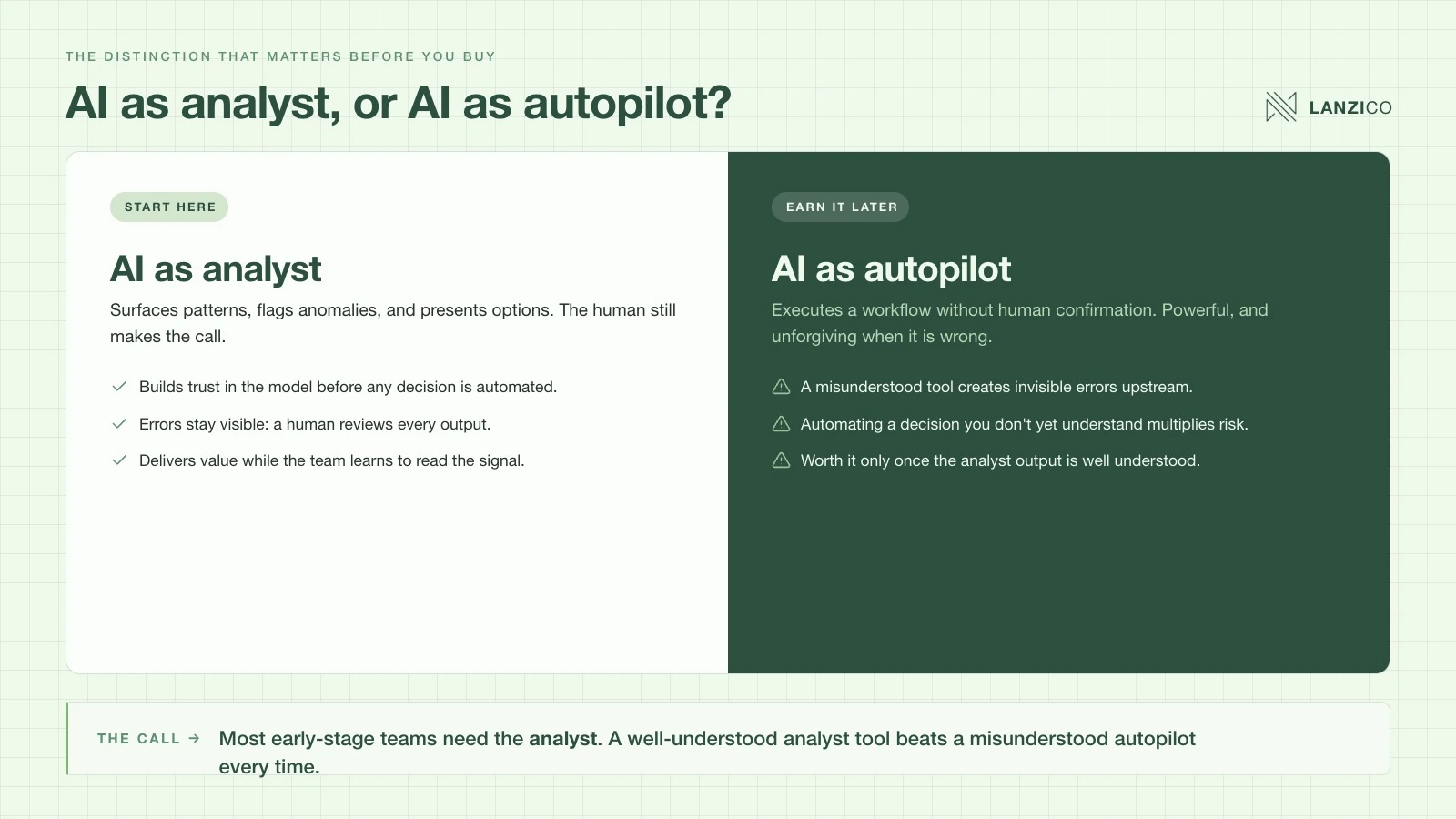
The distinction that matters most before you choose a tool: AI as analyst versus AI as autopilot.
AI as analyst surfaces patterns, flags anomalies, and presents options. AI as autopilot executes a workflow without human confirmation. Most early-stage teams need the former. Build trust in the model before automating the decision. A well-understood analyst tool delivers more value than a misunderstood autopilot creating invisible errors upstream.
The Four RevOps Layers and Where AI Plugs In
Every revenue architecture has four layers. Each has a primary function and a primary question. AI does not change either. It accelerates the answer.
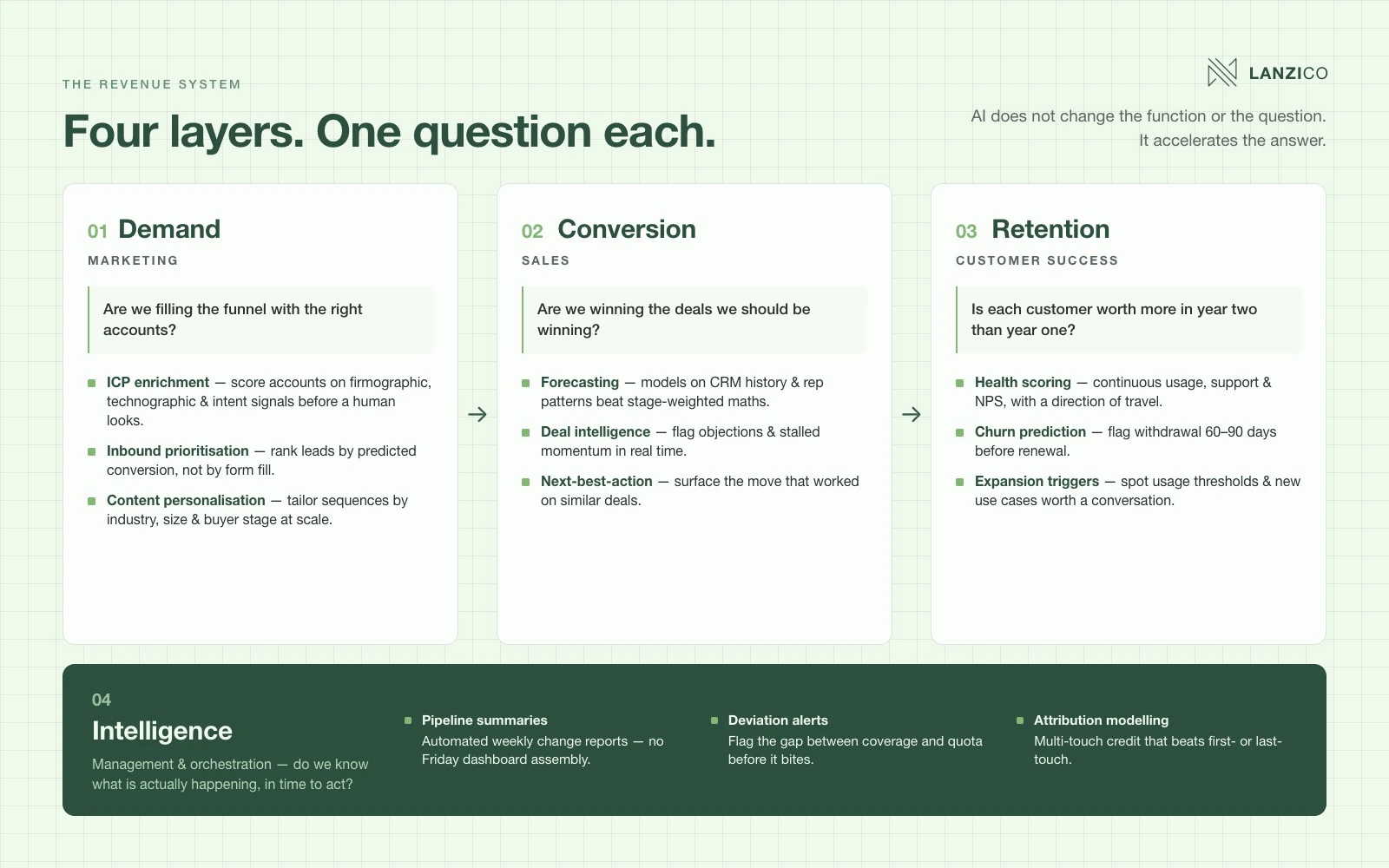
Demand: Marketing
Primary question: are we filling the funnel with the right accounts?
AI applications at this layer:
- ICP enrichment: AI tools pull firmographic, technographic, and intent signals to score accounts before a human looks at them, so SDRs stop prospecting accounts that fit the logo but not the profile.
- Inbound prioritisation: instead of treating every form fill equally, AI ranks leads by predicted conversion probability based on account fit and real-time engagement behaviour.
- Content personalisation: AI-driven personalisation in email sequences and website experiences based on industry, company size, and buyer stage, at a scale a team of two cannot match manually.
What AI cannot do here: define who the ideal customer is. That is a strategic decision that must come from humans before the model has any signal to work with. Garbage ICP definition produces confident-sounding scoring of the wrong accounts.
Conversion: Sales
Primary question: are we winning the deals we should be winning?
AI applications at this layer:
- Forecasting: AI models trained on CRM history, rep patterns, and engagement data outperform stage-weighted forecasting in most mid-market B2B contexts. The accuracy gain comes from detecting patterns across hundreds of past deals, not just the current quarter's pipeline.
- Deal intelligence: conversation intelligence flags competitor mentions, pricing objections, and stalled momentum in real time. Managers can coach on specific calls, not on hunches.
- Next-best-action: AI surfaces the most relevant next move for each open opportunity based on what has historically worked at similar deal stages, with similar account profiles, for the same sales motion.
What AI cannot do here: close the deal. It can tell the rep this opportunity is drifting and that the last three similar deals were saved by a re-demo within a week of stakeholder silence. The rep still has to pick up the phone.
Retention: Customer Success
Primary question: is each customer worth more in year two than in year one?
AI applications at this layer:
- Health scoring: instead of quarterly check-ins determining account health, AI continuously monitors product usage, support volume, NPS trends, and engagement data to produce a real-time score with a direction of travel, not just a snapshot.
- Churn prediction: AI flags accounts showing early withdrawal patterns well before the renewal conversation, giving the CS team enough runway to act, not just react.
- Expansion triggers: AI identifies accounts that have hit usage thresholds, added headcount, or entered new use cases. These are the signals that a commercial conversation would land instead of irritate.
What AI cannot do here: substitute for the relationship. A health score that reads "at risk" still requires a human to have a conversation with enough context to save the account.
Intelligence: Management and Orchestration
Primary question: do we know what is actually happening, in time to act?
AI applications at this layer:
- Automated pipeline summaries: instead of Friday afternoon dashboard assembly, AI-generated summaries flag changes from the previous week: deals that moved, stalled, or entered the pipeline, with no manual input.
- Forecast deviation alerts: AI monitors the gap between current pipeline coverage and what the quarter requires, and alerts the revenue leader when the deviation crosses a threshold worth acting on.
- Attribution modelling: AI processes multi-touch attribution across channels with more accuracy than last-touch or first-touch models, giving marketing a clearer picture of which activities drove revenue rather than which activity got credit.
This is the layer where AI delivers the most visible time savings. It is also where most teams should start, because it requires the least workflow change and produces immediate evidence of value.
The Metrics AI Unlocks That Humans Miss
Some metrics are technically visible in any CRM. In practice, no analyst has time to build them consistently across every rep, every account, every quarter. AI makes these standard.
Conversion rate decay by cohort
How do win rates compare for deals that entered the pipeline in Q1 versus Q3? For deals over 90 days old versus under 30? Cohort analysis reveals whether the pipeline is genuinely healthy or just full.
Rep-level talk-time versus win rate correlation
Conversation intelligence data shows whether reps who talk more or less on discovery calls close more deals. The answer is not universal, but for a specific company and a specific sales motion, it is precise and actionable.
Time-to-first-meaningful-engagement versus close rate
How quickly a rep moves from first contact to a substantive business conversation predicts close likelihood better than most stage-based models. Teams that measure this can set a standard and coach to it.
Account health score trajectory
The snapshot is less useful than the direction. An account with a health score of 65 that was at 80 three months ago is more urgent than an account sitting at 60 with a stable trend. AI surfaces the trajectory, beyond the snapshot number.
What AI for RevOps Is Not
AI does not fix broken processes.
If your CRM data is unreliable, your forecasting model will be unreliable. AI trained on bad data produces confident-sounding nonsense. Clean the data architecture before layering AI on top, otherwise you are automating the problem faster.
AI is not a substitute for a commercial strategy.
An AI-powered forecasting tool sitting on a CRM where reps log one line per opportunity will underperform a spreadsheet built by someone who actually understands the pipeline. AI amplifies what is there. It does not create what is missing.
AI does not eliminate the need for judgement
The pipeline review is still a conversation between people who understand the customer, the competitive situation, and the rep's track record. AI surfaces better data for that conversation more efficiently. It does not replace the conversation.
How to Start: A Three-Phase Approach
Phase 1: Diagnose
Before selecting a tool, map where signal is currently lost. For each of the four layers, answer: what data is being generated, where does it live, and who looks at it?
The most common finding: marketing data sits in one system, sales data in another, customer success data in a third. Nobody has a joined-up view of a single customer's journey. The intelligence layer is three separate dashboards that nobody reconciles.
This diagnostic tells you where AI will have the highest impact. Not which tool to buy.
Phase 2: Activate
Pick one use case with a measurable baseline before you start. Good first choices:
- Forecasting accuracy: if you know your current quarterly forecast error rate, an AI forecasting tool gives you a direct before/after comparison within two quarters.
- Lead conversion rate: if you know your current MQL-to-SQL conversion rate, AI lead scoring produces a clean measurement against a known baseline.
One use case. One baseline. One quarter to measure. Running five simultaneous pilots without baselines produces activity, not insight, and burns budget without evidence.
Phase 3: Scale
Once the first use case has a proven return, integrate AI into the RevOps playbook as a standing tool, not a one-off experiment. That means a documented process for how the AI output feeds each team's weekly workflow, a named owner who monitors model performance, and a quarterly review to catch drift.
This is where most teams fail. They run a successful pilot, declare victory, and six months later nobody is using the tool because it was never built into the way the team actually works.
The Bottom Line
Revenue operations without AI is a reporting function. Revenue operations with AI is a decision engine. The teams that close that gap in the next 24 months will not need to explain why their pipeline is more predictable or their retention is higher. The numbers will do that.
Starting does not require a data science hire, a six-figure platform budget, or a multi-year transformation programme. It requires a clean diagnostic of where signal is being lost, one well-chosen use case, and the discipline to measure before and after.
Running a growth-stage B2B business, an ERP service, a small retail? Not sure which layer of your revenue system is leaking? Let me help you map those processes and start building better revenue activities.