
TL;DR. AI lead enrichment gives you sharper insight on every new lead and keeps it current as buying signals land. But it only pays off on a clean CRM — pour good data into a messy one and you just scale the mess. Used well, it takes the manual research off your plate so your time goes to deciding and selling, not digging.
For founders and sales leads buying enrichment tools. 4-minute read.
You bought the enrichment tool. Every new lead now arrives with company size, funding stage, tech stack, and a job title that looks right. The database is fuller than it has ever been.
Pipeline has not moved.
That is the quiet disappointment behind most enrichment projects: the fields filled, the deals did not. The problem is rarely the tool. It is what the enrichment is sitting on — and what you ask it to do once the fields are full.
AI lead enrichment — automatically pulling external firmographic, contact, technographic, and intent data into your CRM records, and keeping it current as buying signals arrive.
What has to be solid before you enrich anything?
Three foundations, in order: deduplication, field hygiene, routing logic. Get these wrong and enrichment scales the mess faster, with more confidence attached to it.
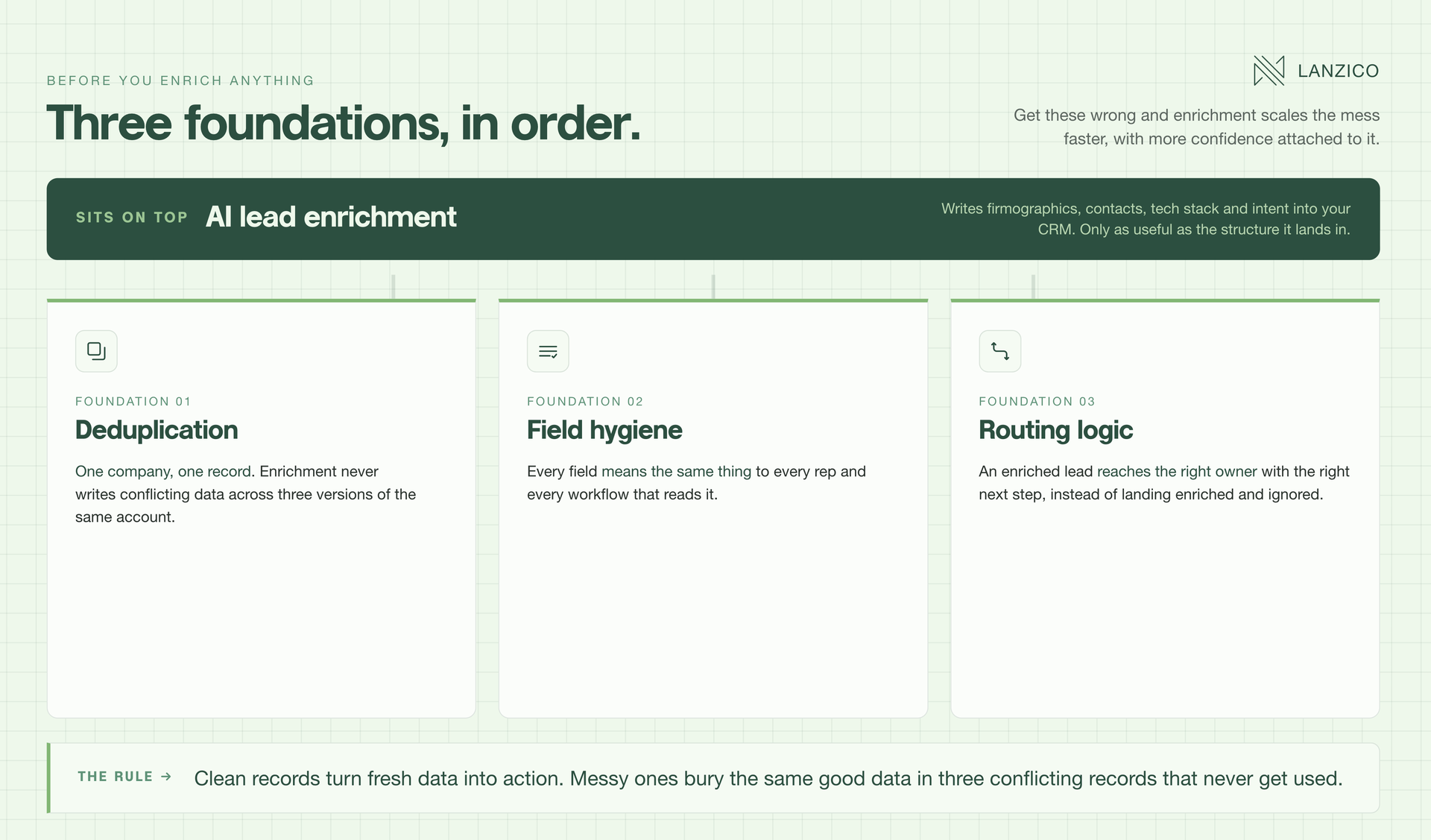
Enrichment writes new external data into your CRM, and it is only as useful as the structure it lands in. Point it at clean, deduplicated records with clear routing and that fresh insight reaches the right person, ready to act. Point it at duplicates and inconsistent fields and the same good data lands in three conflicting records and never gets used.
This matters more because data does not stay accurate. B2B contact data decays at roughly 2% a month, and faster in technology. Enrichment does not fix a broken CRM — it spreads more, fresher data across it, which is exactly why the structure has to come first.
What does AI lead enrichment actually do well today?
It is genuinely good at the digging: collecting firmographics, matching contacts, appending tech stack, and watching for intent signals at a scale no human team can match. This is efficiency, and it is real right now.
The win is not a fuller database. It is a rep who is no longer doing that research by hand, one browser tab at a time. The hours once spent opening LinkedIn, checking the company site, and hunting for funding news go back to the person, to spend on the part that moves deals.
Match rate is not accuracy rate
One distinction separates buyers who get value from buyers who get a fuller, wronger database. Match rate is how many records a tool can fill. Accuracy rate is how many it fills correctly.
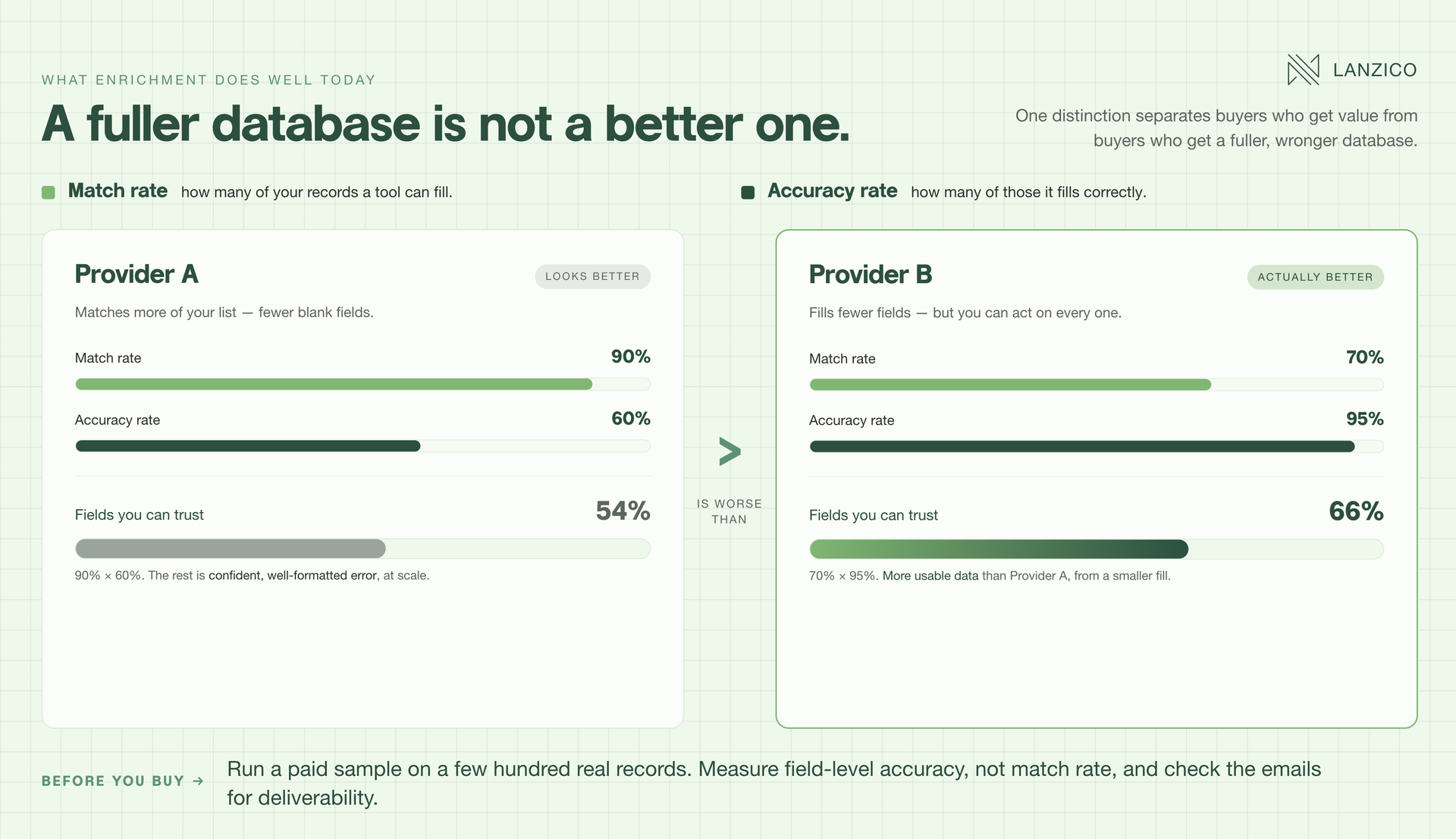
A provider that matches 90% of your list at 60% accuracy is worse than one that matches 70% at 95%. The first hands you confident, well-formatted errors at scale.
Before you buy: run a paid sample on a few hundred real records, measure field-level accuracy rather than match rate, and check the emails for deliverability.
Volume is not the win — signals are
The growth claim is where the hype sits. More enriched data does not produce more pipeline on its own. At any moment only around 5% of your market is in an active buying window. A prospect who just raised a round, posted three relevant roles, or dropped a competitor tool is in a different state from one dormant for six months.
The value of enrichment is extracting that signal and attaching a response to it. Start with two or three signals that actually convert, not fifteen.
So what do you automate, and what stays your call?
Automate the boring research. Keep the decision. The whole point is to make the human faster and more actionable, not to replace them: the tool does the digging so the person does the deciding.
| Task | AI does it | Your call |
|---|---|---|
| Collect firmographics, tech stack, contacts | At scale | — |
| Monitor accounts for buying signals | Continuously | — |
| Decide whether a signal means buy, wait, or ignore | — | Yours |
| Write the outreach that signal earns | — | Yours |
AI flags that an account changed. You decide what it means and whether to act. The finding is mechanical, the decision is judgement — and only one of them should be automated.
How does enrichment plug into the wider revenue motion?
Enrichment is the second stage of the lead-to-cash motion, between demand and qualification, feeding the data layer everything downstream relies on. Run it through the chain that connects the whole motion:
data → insight → orchestration → action → governance.
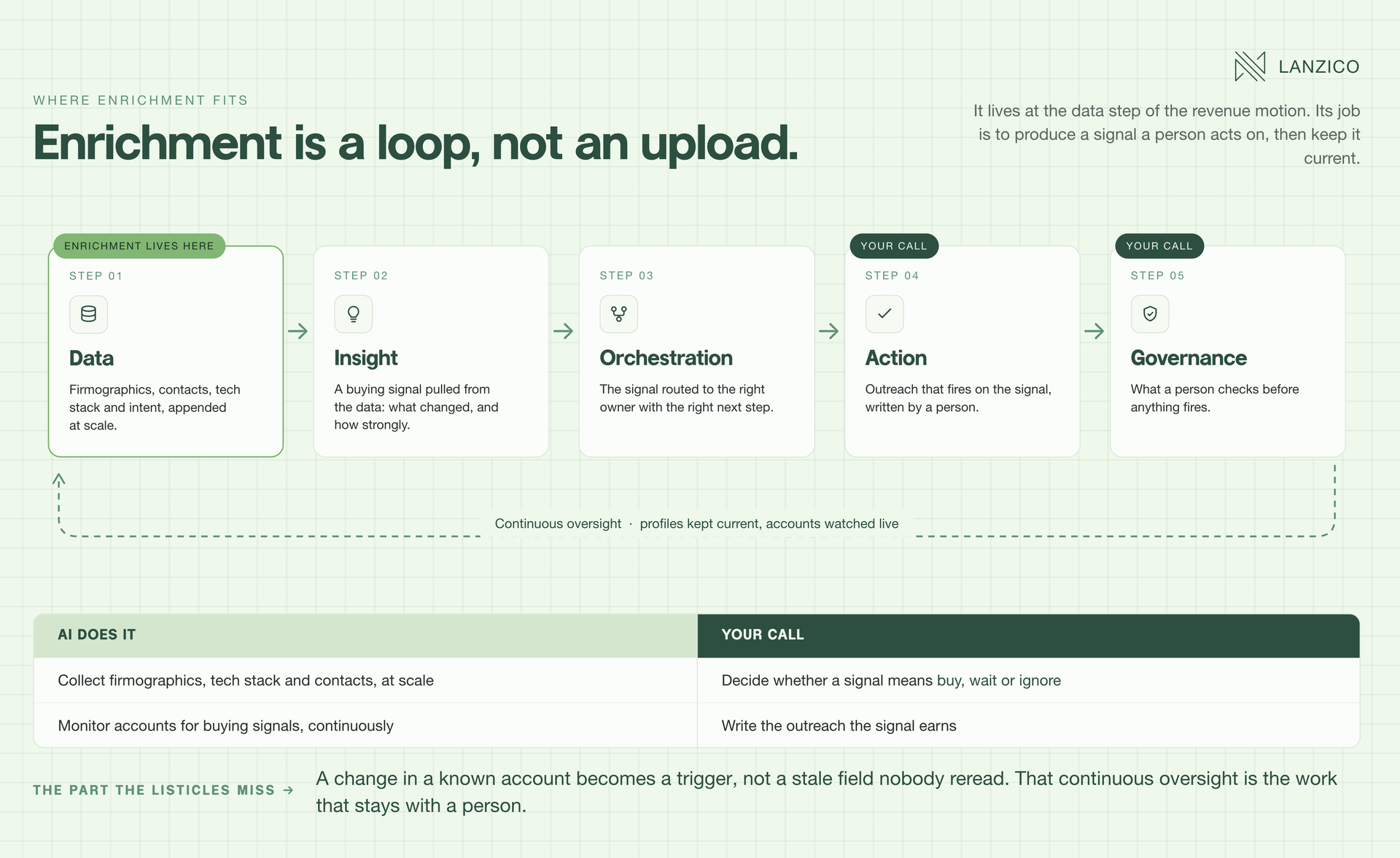
Enrichment lives at data. Its job is to produce insight, which orchestration routes into an action, under governance that decides what a person checks before anything fires.
The mistake is treating enrichment as a one-time event and stopping there.
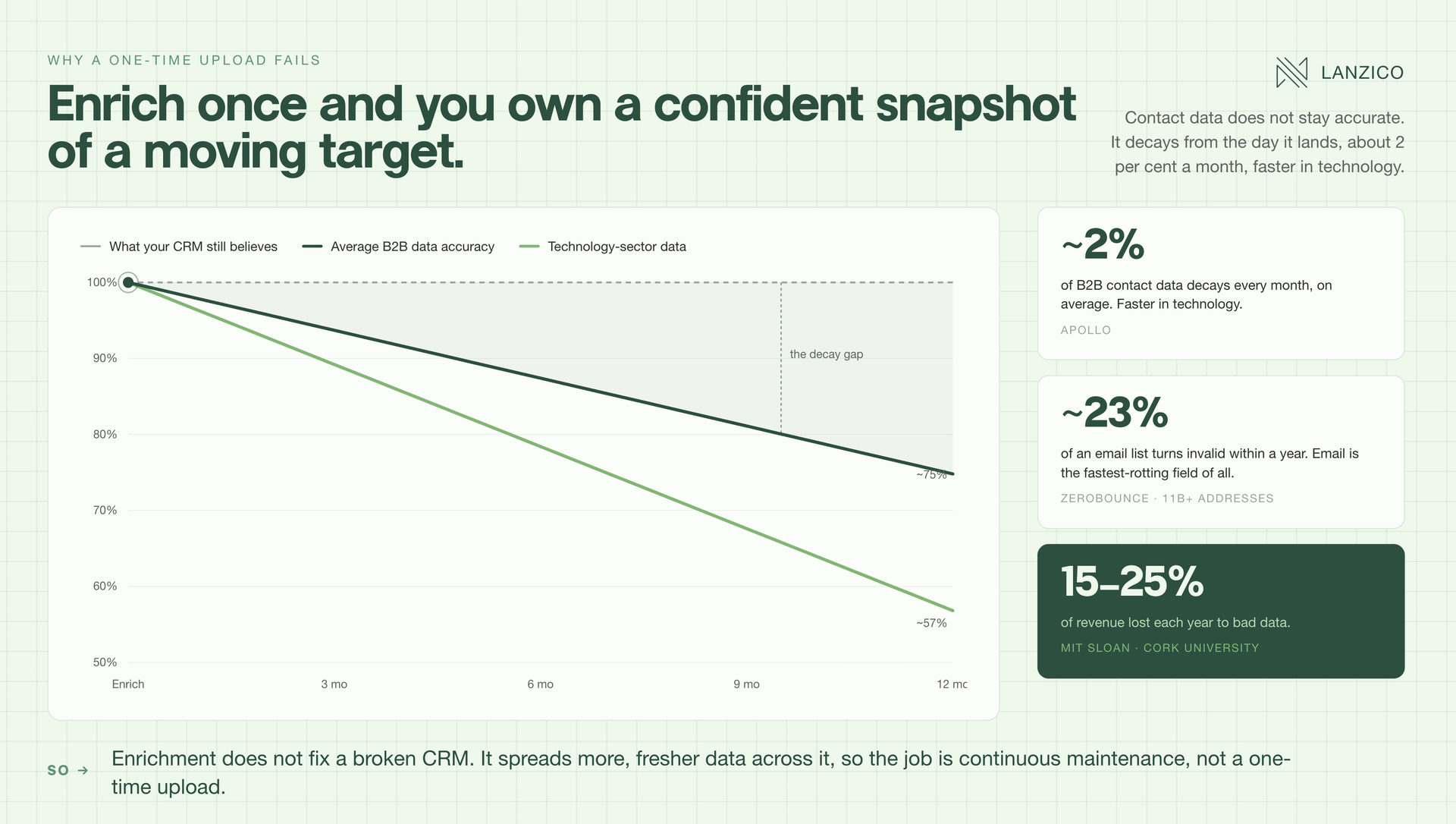
The version that works is a loop: profiles maintained continuously, accounts kept under live watch, so a change in a known account becomes a trigger rather than a stale field nobody reread.
That continuous oversight is the most important part — and the part the listicles never mention.
Key takeaways
- Clean CRM first. Enrichment adds fresh external insight, but only pays on clean data — fix deduplication, field hygiene, and routing, or good data lands in conflicting records.
- Match rate is not accuracy rate. A tool that fills more fields wrongly is worse than one that fills fewer correctly. Test on real records before you buy.
- Signals beat volume. The value is signals you can act on, not fuller fields. Start with two or three that convert.
- Decay is constant. Data rots around 2% a month, so enrichment is continuous maintenance, not a one-time upload.
- Automate the digging, keep the decision. Let it make your team faster and leaner; the call to act stays with you.
FAQ
Is AI lead enrichment worth it for a smaller B2B team?
Yes — if your CRM is clean and you use it for signals rather than raw volume. On a messy database it scales the mess faster and costs you trust in the data.
What should I never fully automate in enrichment?
The decision to act on a signal. AI can find that an account changed; you decide whether it means buy, wait, or ignore.
How often does enriched data need refreshing?
Continuously for active opportunities, given decay of around 2% a month. A 90-day verification cycle is a reasonable floor for the rest, with anything untouched for two years archived rather than re-enriched.
How do I judge an enrichment vendor?
Run a paid sample on a few hundred of your real records, not a demo list. Measure accuracy and field-level fill, not just match rate, and check the emails for deliverability before you commit.
The bottom line
AI lead enrichment is a foundations problem before it is a tooling problem. Clean the data underneath, let the tool take the manual research off your team, and treat enrichment as a continuous loop that turns signals into action. Do that and it compounds:
a leaner team spending its time on decisions, not digging.
Skip it and you are paying to scale a mess with more confidence than it deserves.
Not sure whether your CRM foundations are ready for AI enrichment? Start with the free LanziCo Revenue Intelligence Scorecard and find out where your data stands before you spend.
Sources: data decay and email validity benchmarks (Apollo, ZeroBounce); cost of poor data quality and in-market buyer share (Gartner); revenue lost to bad data (MIT Sloan / Cork University).