
Outbound Without AI Slop: A Playbook for Professional Services
When I started running outbound two years ago, the hardest part was not writing the emails. It was the plumbing. DKIM, DMARC, SPF, warming domains, monitoring deliverability. A week of setup before a single message went out. That part is solved now. You can buy pre-warmed domains directly inside Lemlist or Instantly and skip the whole infrastructure rabbit hole.
The harder lesson took longer to land. Tooling is not the problem with B2B services outbound. The strategy is.
Cold email reply rates fell to 3.43% in 2026, down from around 5% the year before. Seventy-three percent of professionals delete templated outreach on sight. The advice everyone gives is to humanise cold outreach. The advice is right. The execution is where most professional services firms get it wrong, because the playbook they copied was built for SaaS.
The lesson Lemlist taught me
I started with Lemlist for myself, then rolled it out for clients. The B2C and B2B SaaS clients did fine. A €10 monthly subscription has a low entry barrier, so volume works. A buyer can say yes in two minutes.
Services are a different animal. The buyer is not signing up for a tool. They are choosing a team to trust with a problem that matters. That decision needs context, credibility, and timing. A static list cannot supply any of those. I watched well-built Lemlist sequences land in front of the right people at the wrong moment, with the wrong frame, and produce nothing. The infrastructure worked. The strategy did not.
The takeaway: for B2B services, the static list is the problem. Volume is the wrong unit of measurement.
What buyers actually see when they open your email
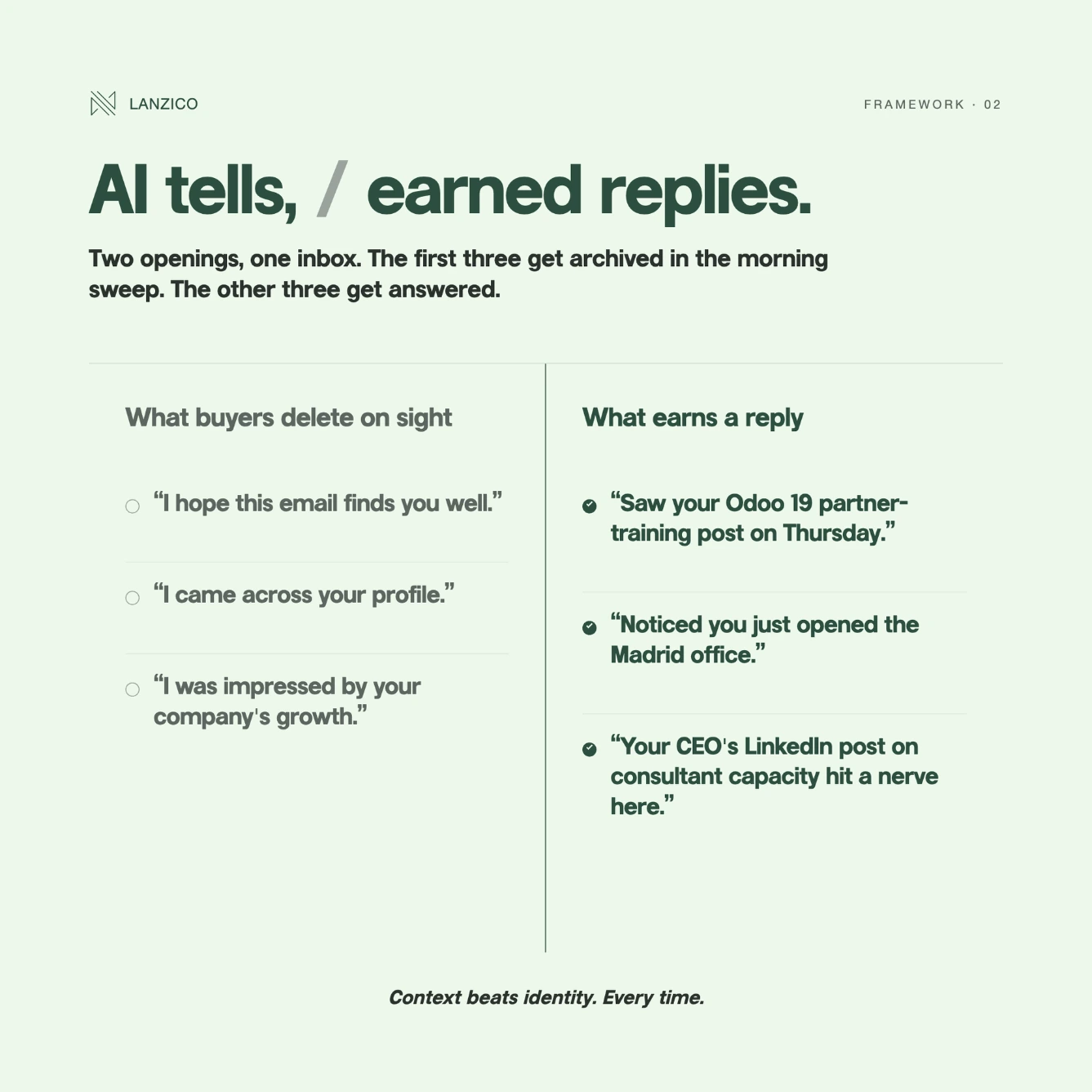
Buyers do not need a tool to spot AI-written outbound. They have learned the tells.
Phrases that announce themselves: "I hope this email finds you well." "I came across your profile." Buzzword clusters: leverage, synergy, scalable. Token-only personalisation, where the first name and the company name get swapped into a template designed for nobody in particular.
The rhythm gives it away even when the phrases do not. AI writes with a uniform cadence: sentence after sentence at roughly the same length, no fragments, no asides. Human writing has burstiness. Short lines next to long ones. The occasional half-thought.
Spam filters now train on the same patterns. Google and Outlook use generative models to classify outbound by structure and route bulk-pattern sends to spam before a buyer sees them. Even a well-intentioned AI-assisted email can fail to reach the inbox.
Clay is incredible. It is also a full-time job.

After Lemlist, most teams move to Clay. I spent considerable time inside it. The product is genuinely powerful. You can enrich a list with thirty data points, build cascading waterfalls, trigger sequences off LinkedIn signals, and stitch Claude in for per-row personalisation. The output, when it works, is impressive.
The catch the marketing leaves out: running Clay properly is a full-time job. Even paired with Claude, automations, and LinkedIn Sales Navigator, the work of identifying the right triggers, the right contacts, and the right opening angle stays complex. The stack removes the typing. The thinking is still on you. Most services firms staffing a one-person growth function burn out before they see the returns.
That is the part I wish someone had told me two years ago.
The Goal-First Outbound Framework
After two years of running this for myself and for clients, the rule that holds up is simple. I call it the Goal-First Outbound Framework: the method should match the goal. The list shape and the goal determine the tool, the cadence, and the channel. Treating outbound as one thing is the mistake most services firms still make.
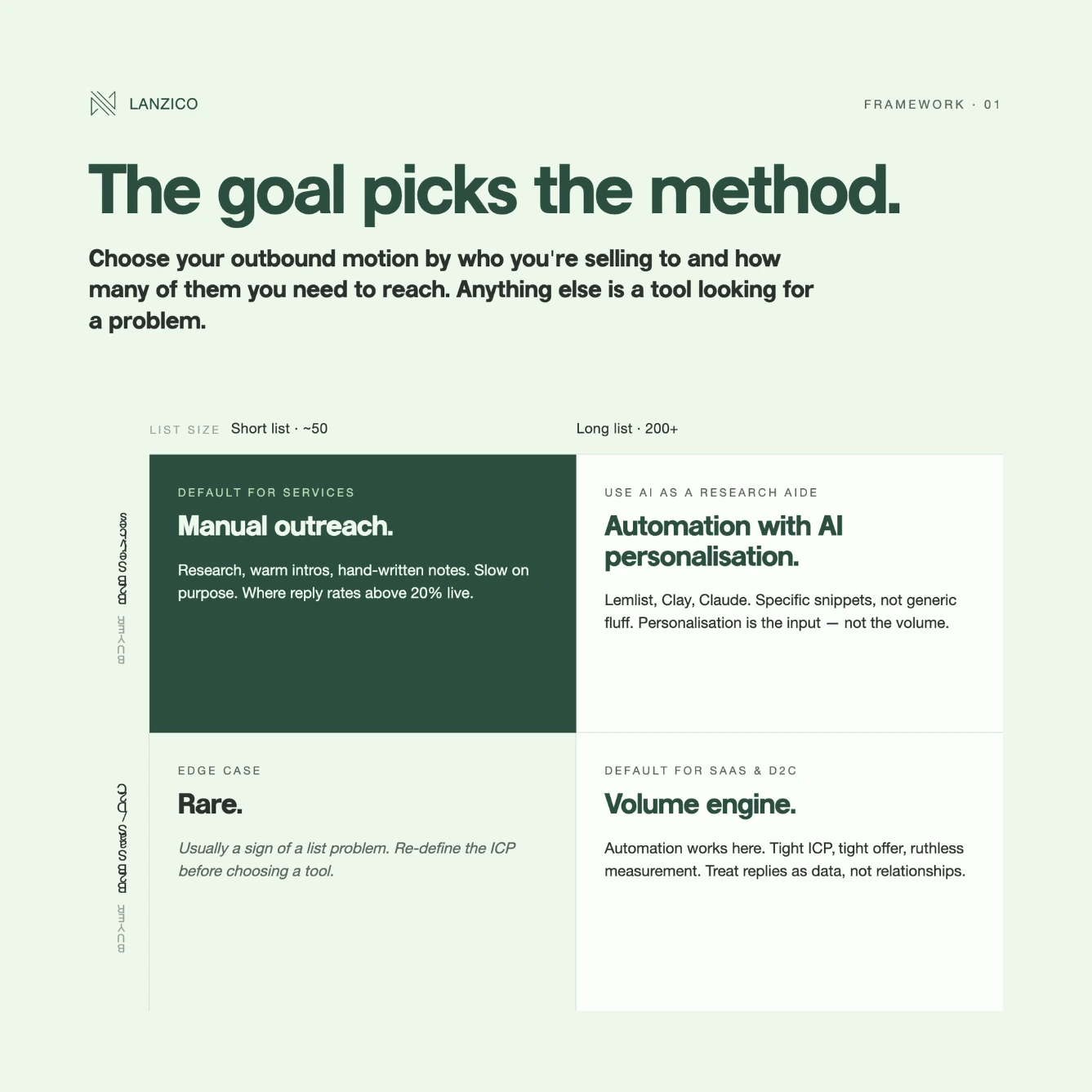
Four scenarios cover almost every case I see.
- Targeting 50 specific people you really want to reach. Manual. Research each one. Look for an introduction. Write a personalised message. It will not scale. It does not need to.
- Targeting a 200-person post-event list. Automation with personalisation makes sense. Lemlist or Instantly for sequencing, Clay for enrichment, Claude for the per-contact angle. You are working a warm list with shared context. Volume is defensible.
- B2B SaaS or direct-to-consumer at scale. Volume still works. The entry barrier is low, the decision is fast, the inbox tolerates more. Automated outbound is a reasonable engine.
- B2B services targeting a specific ICP. Go manual. Research the account, look for the introduction, write the message yourself, send it from the partner or founder account. Slow. Not scalable. Highly effective. This is how B2B services have always sold, and 2026 has not changed the fundamentals.
Mismatch the method and the goal, and the campaign fails even if every other variable is right.
How to humanise cold outreach in practice
Across the services firms I work with, the pattern that consistently works has three traits.
Shorter, signal-triggered lists.
Outreach goes out when something tangible has happened in the prospect's world. A new hire that signals process change. A funding round. A product launch. A LinkedIn post from the CEO complaining about a problem the firm solves. Signal-based outreach lifts reply rates into the 15 to 25% range, a 5x improvement over generic sends.
+ Email and LinkedIn, combined.
Single-channel sequences are losing. Email reinforced by a LinkedIn touch from a real person, plus a 30-second Loom dropped into the thread, performs measurably better. The buyer sees a face. Hears a voice. The send stops looking like a send.
Context over identity.
Anyone can merge a first name. The differentiator is referencing the prospect's specific situation: the migration they posted about last week, the city they just expanded into, the partner certification they just earned. Context says, "a human read your world before writing to you."
There is a small trick I lean on for the manual sends. Open a voice memo. Talk for two minutes about why this prospect, what was noticed, what would be said across a table. Transcribe. Edit lightly. Send. The output keeps the cadence, the hesitation, and the specificity that AI cannot reproduce. I call it the voice-memo-to-text trick. It is the cheapest way I know to write outbound that does not sound like outbound.
How LanziCo runs outbound for services clients
The pattern repeats with every Odoo Partner and services firm we work with. The team starts the engagement convinced they need more volume. The audit reveals the opposite. Volume is the problem.
A typical fix: cut send volume by 80%. Replace static lists with a signal feed (hiring, funding, leadership change, content engagement, tech stack changes). Drop email-only sequencing in favour of email plus LinkedIn plus Loom. Move the partner or founder into the first touch personally for the top accounts. Track reply rate and meetings booked. Send volume stops being a metric.
The results follow a consistent pattern: fewer sends, better deliverability, higher reply rates, and outbound that finally sounds like the firm doing it.
The Bottom Line
Outbound for B2B services in 2026 is a different game than outbound for SaaS. The infrastructure got easy. The judgement got harder. The way to humanise cold outreach is to match the method to the goal: manual for the high-value ICP plays, automation for the post-event volume plays, and signal-triggered short lists for everything in between.
The firms that learn this first will own outbound for the next cycle. The bar has fallen so low that anyone who clears it stands out.
Running an Odoo Partner or services firm and watching reply rates fall? Start with a LanziCo Growth Gap Diagnostic. We will show you exactly where outbound is leaking, and what to rebuild first.